

If you are a small business owner of any kind, you probably did not start your company because you were excited about bookkeeping. You started your business because you had a skill, a service, or a product you believed in, and a way to help people and serve your community. Then the reality set in. Money comes in, money goes out, and somebody has to keep track of all of it.
Truly, most business owners are not trying to be careless with their books, but there is so much else always vying for your time and attention. You are trying to keep the doors open, serve customers, manage staff, and make payroll. Bookkeeping becomes something you handle in the back office after hours when your brain is already fried, and there are a million other places that you’d rather be. The problem is that bookkeeping mistakes rarely show up when they are small. They show up later, when they are more expensive and harder to fix.
The moment all those little bookkeeping mistakes tend to become obvious is tax season. Your CPA asks for financial statements. You send what you have. Then you start to get questions you cannot answer quickly.
“Why does the balance sheet show a negative number in this account?”
“Why is the loan balance different than the lender statement?”
“Why do the bank statements not match the books?”
And the worst question of all, “Why are your personal expenses mixed into business expenses?”
That is when it really hits you square between the eyes. Bookkeeping is not just data entry. It is the foundation of faithful financial management.
Avoiding bookkeeping mistakes is not only about avoiding tax errors. Inaccurate books affect cash flow, reporting, planning, and business decisions. When financial reports are unreliable, you will second-guess every decision you try to make. “Can I afford a new employee?” “Is this location profitable?” “Do I have enough money to order inventory?” “Should I raise prices?”
Reliable financial data gives you confidence. Inaccurate financial records create stress.
The good news is that most bookkeeping mistakes are simple errors and relatively easy to fix, especially when you catch them in time.
To be honest, they usually happen partly because bookkeeping feels simple on the surface. Reliable accounting software, like QuickBooks, makes it easy to record business transactions and check a box on your to-do list that says you reconciled accounts.
But software alone does not see the whole picture. Software does not know whether your chart of accounts is set up correctly.
- It does not know whether a transaction should be split.
- Software does not know whether you are mixing business funds with personal bank accounts.
- It will happily produce financial reports even when the underlying financial information is wrong.
Below is a list of common bookkeeping mistakes I see with small businesses. Some of these are small errors that can be fixed quickly.
Others can create major problems over time, but all of them are easier to prevent than to clean up later. Coming from someone who has spent a lot of hours cleaning up bookkeeping mistakes for small business owners, an ounce of prevention really is worth a pound of cure.
The Hidden Cost of Bookkeeping Mistakes
Bookkeeping mistakes are often brushed off as an inconvenience, but the real cost goes far beyond the frustration at tax time.
Bookkeeping mistakes cost you time.
When bookkeeping issues pile up, business owners spend hours tracking down transactions, searching for receipts, and answering questions they should not have to answer. That time is taken away from serving customers, managing staff, and growing the business.
Bookkeeping mistakes cost you money.
Cleanup work almost always costs more than ongoing bookkeeping. Fixing months or years of errors requires reviewing bank statements line by line, reclassifying transactions, and rebuilding financial reports entirely. In many cases, missed deductions, penalties, or delayed filings add to the financial impact.
Bookkeeping mistakes cost you missed opportunities.
When financial information is unclear, business owners hesitate. Hiring decisions are delayed. Equipment purchases are postponed. Pricing adjustments are avoided. Growth opportunities are missed not because the business cannot afford them, but because the numbers cannot be trusted.
Bookkeeping mistakes cost you peace of mind.
Constant uncertainty about cash flow, tax obligations, and financial health weighs heavily on business owners. Over time, that stress affects confidence and decision-making.
Fortunately ALL of these costs are preventable. Catching bookkeeping issues early and maintaining clean, consistent records throughout the year is almost always less expensive than fixing problems later. In that sense, good bookkeeping is not an expense. It is a form of protection.
9 Bookkeeping Mistakes You Can Easily Avoid as a Small Business Owner
1. Trying to Do Your Own Bookkeeping Without Understanding Accounting Basics
There is nothing wrong with doing some of your own bookkeeping, especially early on. In fact, doing some bookkeeping (with the right knowledge foundation) can help you understand how money moves through your business. The problem starts when bookkeeping becomes nothing more than data entry.
Bookkeeping breaks down when transactions are recorded without understanding how they affect the financial health of your business. Categorizing expenses without understanding what those categories represent often creates books that look fine at a glance but fall apart when you try to use them for real decisions (like taxes).
Most DIY bookkeeping issues stem from a single core problem. Transactions are recorded without understanding their impact on assets, liabilities, and equity.
Business owners may record transfers between accounts as income, expense large purchases that should be tracked as assets, misclassify loan payments, or rely only on the profit and loss statement while ignoring the balance sheet.
Because, FYI-the balance sheet is not an extra report. It shows what your business owns, what it owes, and whether it is building stability or quietly accumulating risk. When accounts are misused, the balance sheet becomes unreliable, even if income and expenses look reasonable.
This matters even more for franchise owners and brick-and-mortar businesses, where loans, equipment, inventory, and long-term obligations add complexity.
If you plan to do any of your own bookkeeping, three things are non-negotiable. You need to review more than just income and expenses. You need to reconcile your accounts consistently. And you need to know when to stop doing it yourself. (#sorrynotsorry)
If you are guessing where transactions belong or unsure how reimbursements, transfers, or loan payments should be recorded, it is time to bring in professional help. Fixing small issues early is far less expensive than cleaning up months or years of incorrect data.
Go ahead and book a call here if you cringed even a little bit at that first mistake.
2. Setting Up Accounts Incorrectly From the Start
One of the most damaging bookkeeping mistakes happens before most business owners even realize they have a bookkeeping system. Accounts are set up incorrectly from the beginning, and every transaction recorded afterward is affected by that foundation.
Accounting software makes it easy to create new accounts, but it does not explain how those accounts should be structured or how they affect your financial statements. Even when accounts are set up incorrectly, reports may be generated, but they do not tell the truth.
Common problems include:
- recording loans as income instead of liabilities
- recording owner contributions as revenue
- setting up expenses as bank accounts
- creating too many unclear accounts that fragment financial data
These issues quietly distort the balance sheet. For businesses that rely on financial reports for lenders, franchisors, or long-term planning, this can create serious problems.
The fix is a clean, intentional chart of accounts. Every account should have a clear purpose. Loans should be liabilities. Owner contributions should affect equity. Assets such as equipment should be tracked properly instead of being expensed incorrectly.
If your financial reports are confusing or require frequent explanation, the issue is often not the transactions themselves but the way the accounts are structured.
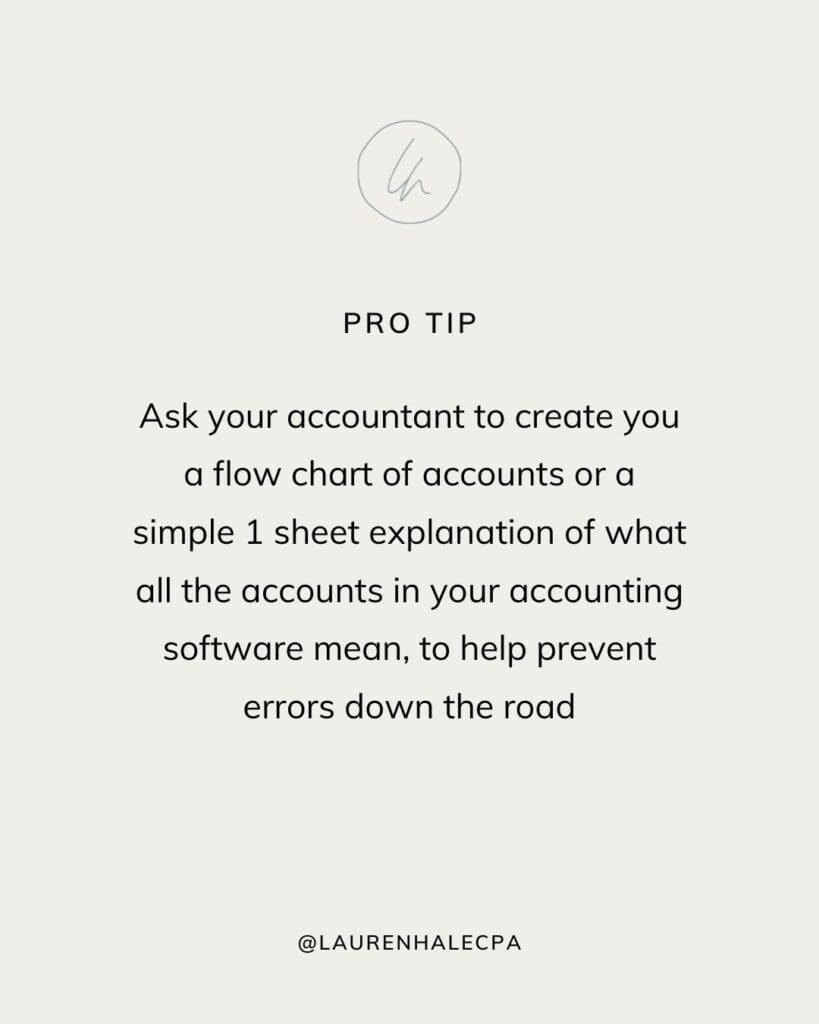
Pro Tip: Ask your accountant to create you a flow chart of accounts or a simple 1 sheet explanation of what all the accounts in your accounting software mean. Even if you’re not doing your own books, it’s still helpful to understand what everything means.
3. Not Reconciling Bank and Credit Card Accounts Regularly
Though we aren’t really a fan of credit cards (Dave Ramsey Pro here) Skipping reconciliation of either debit cards or credit cards is one of the fastest ways for bookkeeping errors to pile up unnoticed.
Reconciliation is simply the process of confirming that what is recorded in your bookkeeping system matches what actually happened in your bank and credit card accounts. Without it, there is no reliable way to know whether your books reflect reality.
When reconciliation is skipped, duplicate transactions, missing charges, bank fees, interest, and timing differences quietly distort the books. Reports still generate, but they are built on shaky data.
At tax time, unreconciled accounts turn preparation into cleanup. Months of statements must be reviewed line by line. Stress and costs increase.
Monthly reconciliation is one of the simplest best practices in small business bookkeeping. It turns bookkeeping data into trustworthy financial information.

4. Recording Loan Payments Incorrectly
Loan payments are one of the most commonly misrecorded transactions in small business bookkeeping.
A loan payment is rarely a single thing. It usually includes principal and interest. When the entire payment is recorded as an expense, loan balances do not decrease correctly and interest expense is misstated.
This affects both the profit and loss statement and the balance sheet. It also affects decision-making. Business owners rely on loan balances to evaluate risk and plan growth. If those numbers are wrong, decisions are based on incomplete information.
Every loan should be set up as a liability. Payments should be split between principal and interest. Loan balances should also be compared to lender statements periodically.
If the balance sheet does not match what the lender says you owe, the books are not telling the full truth.
5. Confusing Gifts, Charitable Contributions, and Advertising
This is one of the most common bookkeeping mistakes I see, especially among generous, community-minded business owners.
Though all a blessing to your community, gifts, charitable contributions, and advertising are treated very differently for bookkeeping and tax purposes. When they are lumped together, deductions may be overstated, understated, or disallowed entirely.
Donations to individuals are not considered charitable contributions. (Yes, even those GoFundMe donations to help a friend or family in need.) Sponsorships that promote your business are often advertising (not charitable contributions). Also, business gifts may have limits and documentation requirements.
The fix is to ask one simple question: what was the primary purpose of this expense?
Document the intent and categorize consistently. Clear records protect both your books and your peace of mind.
Want to learn more about giving and being a generous business owner? Read this
6. Assuming the Accountant Will Sort Everything Out at Tax Time
Many business owners just assume bookkeeping issues can be fixed later because they work with a CPA for their taxes. While some corrections are possible, this mindset turns bookkeeping into a yearly crisis.
When inaccurate books are handed to a CPA, tax preparation becomes cleanup PLUS tax prep. Planning opportunities are lost (ie those end of year purchases you could have made). Fees increase. Stress rises.
Sales tax, payroll tax, and contractor reporting issues often cannot be fixed easily after the fact. Deadlines matter.
Ongoing bookkeeping allows you to have a more holistic tax strategy and for your tax preparation to be proactive instead of reactive.
7. Mixing Personal and Business Expenses
Mixing personal and business expenses is one of the fastest ways to create confusion in your books.
It often starts with convenience. A personal card is used for a business purchase. A business account covers a personal expense with the intention of paying it back later.
Over time, the line between business money and personal money blurs. Financial statements become unreliable. Tax preparation becomes more complicated.
The fix is a clean separation. Use a dedicated business bank account and business credit cards. Track reimbursements intentionally. Address questionable transactions immediately.
Clear separation protects the accuracy of your books and your peace of mind.
8. Not Realizing How Bookkeeping Impacts Tax Strategy
Bookkeeping and tax strategy are absolutely not separate. (Reason number 1,245 why we love being able to offer tax strategy, tax preparation, and bookkeeping for you all in house). Tax planning is only as good as the financial data that supports it.
When books are inaccurate or outdated, tax conversations become reactive. When books are clean and current, tax planning becomes strategic.
Accurate bookkeeping allows your CPA to identify opportunities, evaluate timing decisions, and help you prepare instead of react.
The fix is not thinking about taxes more often, no, no, no. The fix is to improve the quality of the financial information that feeds those decisions.
9. Waiting Too Long to Ask Questions
One of the most expensive bookkeeping mistakes is waiting too long to ask questions.
Small issues rarely stay small. A miscategorized transaction becomes a pattern. An unreconciled account gets even more unreconciled. A confusing balance grows.
Business owners often delay asking questions because they are busy or assume it will resolve itself. In reality, early questions prevent costly cleanups later.
If something does not make sense, it deserves attention now, not later.
Early Warning Signs Your Books Need Attention
Many bookkeeping problems give subtle, but true warning signs long before they turn into major issues. Call these red flags that you need to call in help for your bookkeeping
- Avoiding financial reports because they feel confusing or overwhelming
- Being surprised by account balances
- Feeling unsure whether the business is truly profitable
- Discovering issues only at tax time are others
- Frequent “we’ll fix it later” conversations
- Difficulty explaining numbers to a CPA or lender
- Uncertainty around cash flow
Truly, though, these signs do not mean you have failed. They simply mean that bookkeeping isn’t your strongest suit and isn’t why you started your business. Which is OKAY, because, we love bookkeeping and helping people like YOU is why we started our business!
Addressing these issues early is one of the most effective ways to protect the financial health of your business and reduce stress going forward.
What Changes When Ongoing Bookkeeping Is Handled The Right Way?
Many business owners assume ongoing bookkeeping simply means someone else enters transactions. In reality, the difference between reactive bookkeeping and ongoing bookkeeping is far more significant.
Before ongoing bookkeeping, financial reports are often confusing or ignored. Cash flow feels unpredictable. Tax conversations are rushed and backward-looking. Decisions are made cautiously because the financial picture is unclear.
After ongoing bookkeeping is in place, the experience changes.
Accounts are reconciled consistently. Financial statements become reliable tools instead of documents to avoid. Business owners understand where their money is going and why. Conversations with a CPA focus on planning instead of cleanup.
When business owners trust their numbers, they make decisions with confidence. Hiring feels less risky. Pricing adjustments are grounded in reality. Growth conversations are based on facts instead of guesswork.
Ongoing bookkeeping does not remove every challenge of running a business, but it removes unnecessary uncertainty. It replaces reaction with preparation and stress with clarity.
Why Ongoing Bookkeeping Makes a Difference
Ongoing bookkeeping can change everything.
Problems are caught early. Accounts are reconciled regularly. Documentation stays current. Financial statements reflect reality instead of some pie in the sky numbers.
Instead of avoiding your numbers, you use them. Instead of guessing, you know. Conversations with your CPA become proactive instead of corrective.
Good bookkeeping does not eliminate challenges, but it removes unnecessary confusion and stress.
Final Thoughts on the Top Bookkeeping Mistakes to Avoid
Wherever you are at in the bookkeeping side of your business, take heart. We are most certainly NOT here to judge you or make you feel shamed. Most bookkeeping mistakes are not caused by carelessness. They are caused by trying to manage complex financial systems without the right structure or support.
Scripture reminds us that when we are faithful with little, we can be trusted with much. (Luke 16:10) That applies to business finances just as much as personal ones.
Good bookkeeping is not about perfection. It is about consistency, clarity, and honesty. It is about knowing where your business stands so you can lead it well.
If you see yourself in any of these bookkeeping mistakes, you are not alone. We’ve helped so many small business owners take control of their books and start feeling the freedom and peace of mind that comes with knowing where your business stands financially.
If you do not already have a trusted bookkeeper and CPA on your team, reach out to see if we’re a good fit to help you.

